Lighthouse Collection
Atlantic markers, coastal beacons, dusk light, and weather. The flagship collection and future coffee table book.
About the Collection
The Lighthouse Collection is the first true commercial collection from Boundless Studios — visually iconic, highly collectible, and naturally suited to both framed prints and a coffee table book.
Each lighthouse is a marker — of coastline, of weather, of the boundary between land and sea. This collection follows the Atlantic coast from New England south, capturing beacons in every kind of light.
Coffee Table Book
The Lighthouse Collection will become a limited-edition coffee table book — a curated sequence of images, place notes, and coastal stories.
Join the waitlist to be notified when preorders open.
St. Augustine Light
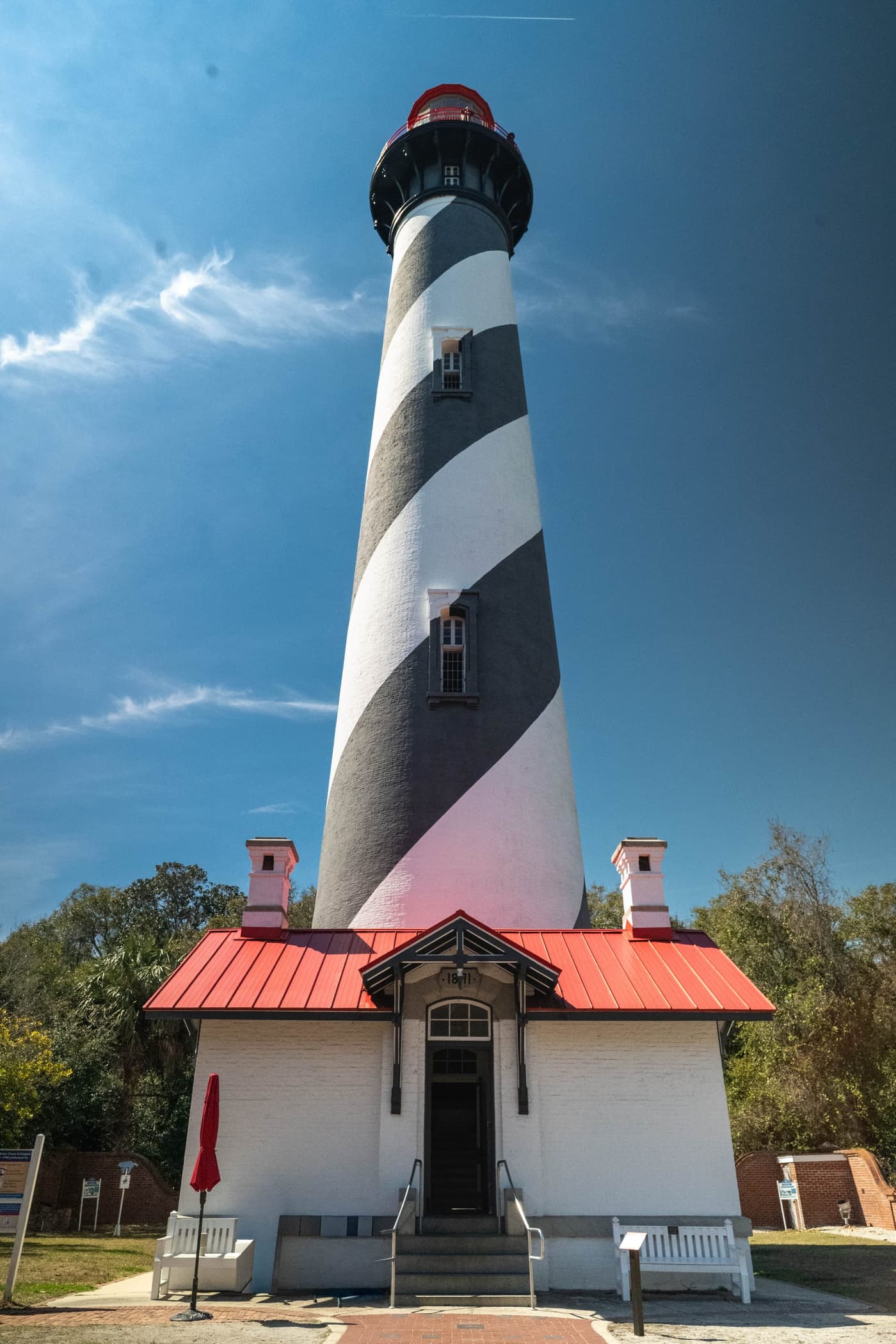
Standing 165 feet over Anastasia Island since 1874, the St. Augustine Lighthouse is one of the most recognizable beacons on the Atlantic coast. Its black-and-white spiral daymark — painted in bold barber-pole stripes so mariners could distinguish it from other towers by day — cuts against Florida sky at any hour. The tower replaced an earlier Spanish watchtower that had guarded the inlet since the 1500s, making this stretch of coast one of the longest continuously marked in the Western Hemisphere.
Inside, a cast-iron staircase winds 219 steps to the lantern room, each tread worn smooth by a century and a half of keepers and visitors. The spiral is one of the most photographed interiors on the Atlantic — a black-and-white geometry of iron, light, and negative space that draws the eye straight up through the center of the tower. The original first-order Fresnel lens is gone, replaced by a modern optic, but the tower still throws light 24 nautical miles out to sea.
It earns its place in the collection at dusk — when the lantern room catches the last warm light, the marsh behind it goes quiet, and the oldest continuously inhabited city in America settles into another evening beneath its beam. The keeper's house at its base, painted in Victorian red, now serves as a maritime museum, but the tower itself remains what it has always been: a fixed point on a shifting coast.

Currituck Beach Light
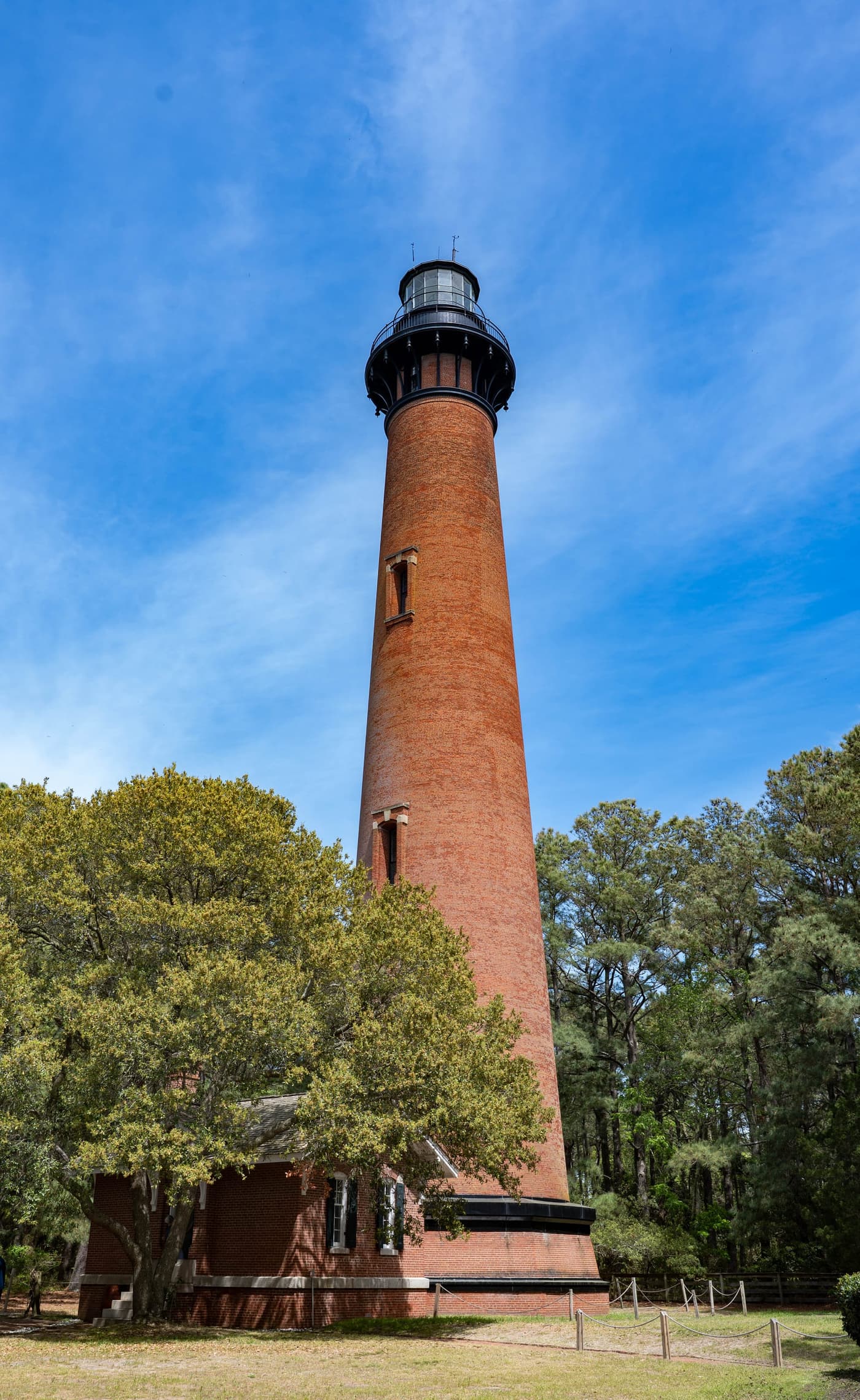
Rising 162 feet above the live oaks of Corolla, the Currituck Beach Lighthouse is one of the few unpainted brick towers left on the Atlantic seaboard. Lit on December 1, 1875, it was built to fill the last dark stretch of coastline between Cape Henry to the north and Bodie Island to the south — a 40-mile gap where shipwrecks were routine. Its red brick was left exposed by design, a deliberate daymark meant to distinguish it from the painted towers on either side.
Inside, the original iron staircase spirals 220 steps to the lantern room, the metalwork weathered green with salt and time. The climb is narrow and deliberate — each landing framed by small windows that let in slices of marsh light and the sound of wind through the live oaks below. The first-order Fresnel lens was removed in the 1930s when the light was automated, but the tower was restored in the 1980s and relit, its beam once again sweeping the northern Banks.
It stands at the edge of the Outer Banks' wildest reach — Corolla's sand roads, the feral horse country, the point where the pavement gives out and the coast takes over. The Whalehead Club, a 1920s Art Nouveau hunting lodge, sits in its shadow, and the wild Colonial Spanish mustangs roam the dunes just north. Of all the lighthouses in the collection, Currituck is the one that feels most like it belongs to the land rather than the sea.


Bodie Island Light
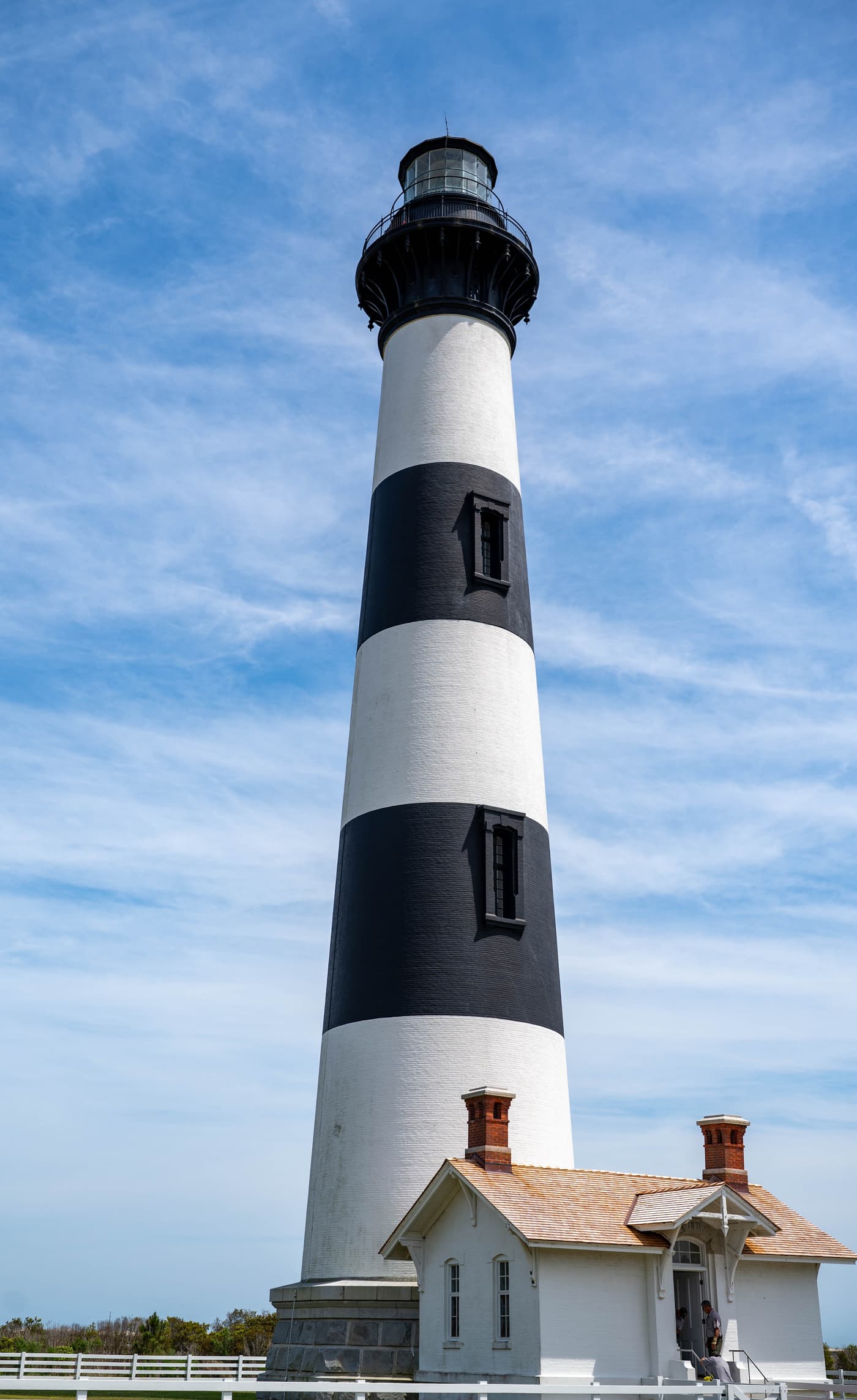
The third tower to bear the name, Bodie Island Lighthouse has stood watch over the northern Outer Banks since 1872 — 156 feet of white brick banded with two bold black horizontal stripes. The first tower, built in 1847, leaned so badly it had to be abandoned. The second was destroyed by retreating Confederate forces in 1861. This one held. Its horizontal bands were a deliberate daymark — the only one of its kind on the Carolina coast — so that mariners approaching from sea could identify it instantly against the flat barrier island horizon.
Its original first-order Fresnel lens, one of the few still operating in the United States, remains in the lantern room — a handmade masterpiece of French glass and brass that has been throwing its beam 19 nautical miles across Oregon Inlet and the barrier islands for over 150 years. The lens alone weighs more than a ton and produces a signature flash pattern that sailors still use for navigation. When the Park Service restored the tower and reopened it to climbers in 2013, they made the deliberate choice to keep the original lens in place.
The tower sits in a stretch of marshland between Pamlico Sound and the Atlantic, surrounded by nothing but reeds, sky, and the low hum of wind through sea grass. There are no towns nearby, no boardwalks, no gift shops crowding its base — just the keeper's quarters, the marsh, and the light. At dawn the reflection doubles in the still water at its base. At dusk the black bands disappear into shadow and the white brick catches the last pink light off the sound. It is the quietest lighthouse on the Outer Banks, and the most honest.


Ocracoke Light
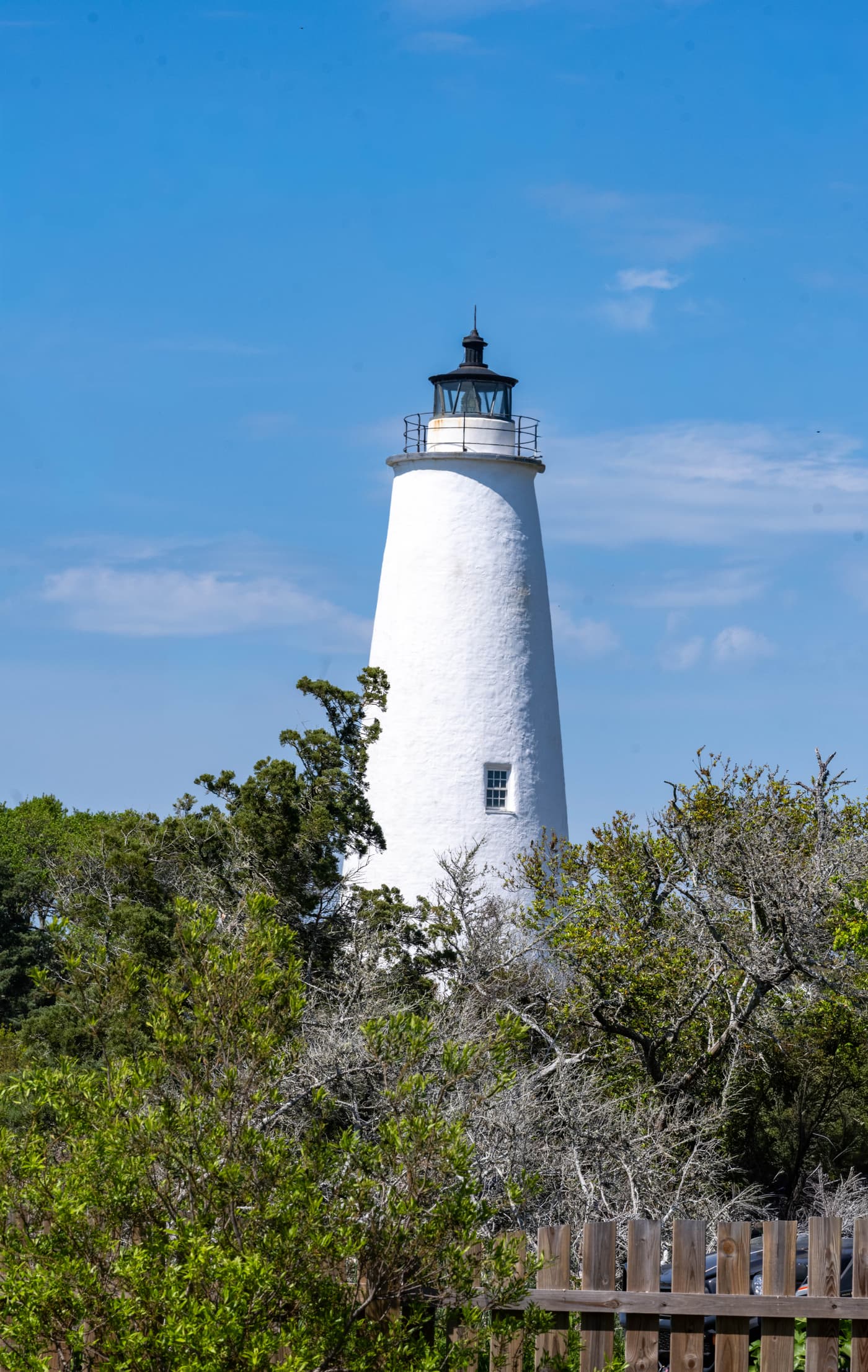
At just 75 feet, the Ocracoke Lighthouse is the shortest of the Outer Banks beacons — and the oldest continuously operating light in North Carolina. Built in 1823 to replace an earlier wooden tower destroyed by lightning, its solid brick walls are five feet thick at the base and taper to two feet at the top. Where Bodie wears black bands and Currituck wears bare brick, Ocracoke wears nothing at all. The plain white tower is its own daymark — a deliberate choice, distinct against the dark live oaks and saltbox houses of the village that surrounds it.
Its original fourth-order Fresnel lens has long since been replaced, but the light it throws is one of the rarest signals on the Atlantic seaboard: a fixed white light that does not flash. While almost every other lighthouse in the country was converted to a rotating beacon to give it a unique signature, Ocracoke kept its steady glow — a constant white eye that mariners approaching the inlet have looked for in the same way for two centuries. The keeper's quarters at its base, a low white double-pile cottage with a gabled roof, still stands beside it under the same pair of ancient live oaks.
Ocracoke is reachable only by ferry, and the village around the light still speaks with the soft Outer Banks brogue — a dialect older than the lighthouse itself, kept alive by isolation. There are no high-rises, no condominiums, no bridge to the mainland. Just sand roads, fish houses, weathered porches, and a short white tower glowing steadily at the edge of the village. Of all the lighthouses in the collection, Ocracoke is the most domestic — the one that feels less like a beacon and more like a candle left burning in a kitchen window for two hundred years.


Old Baldy
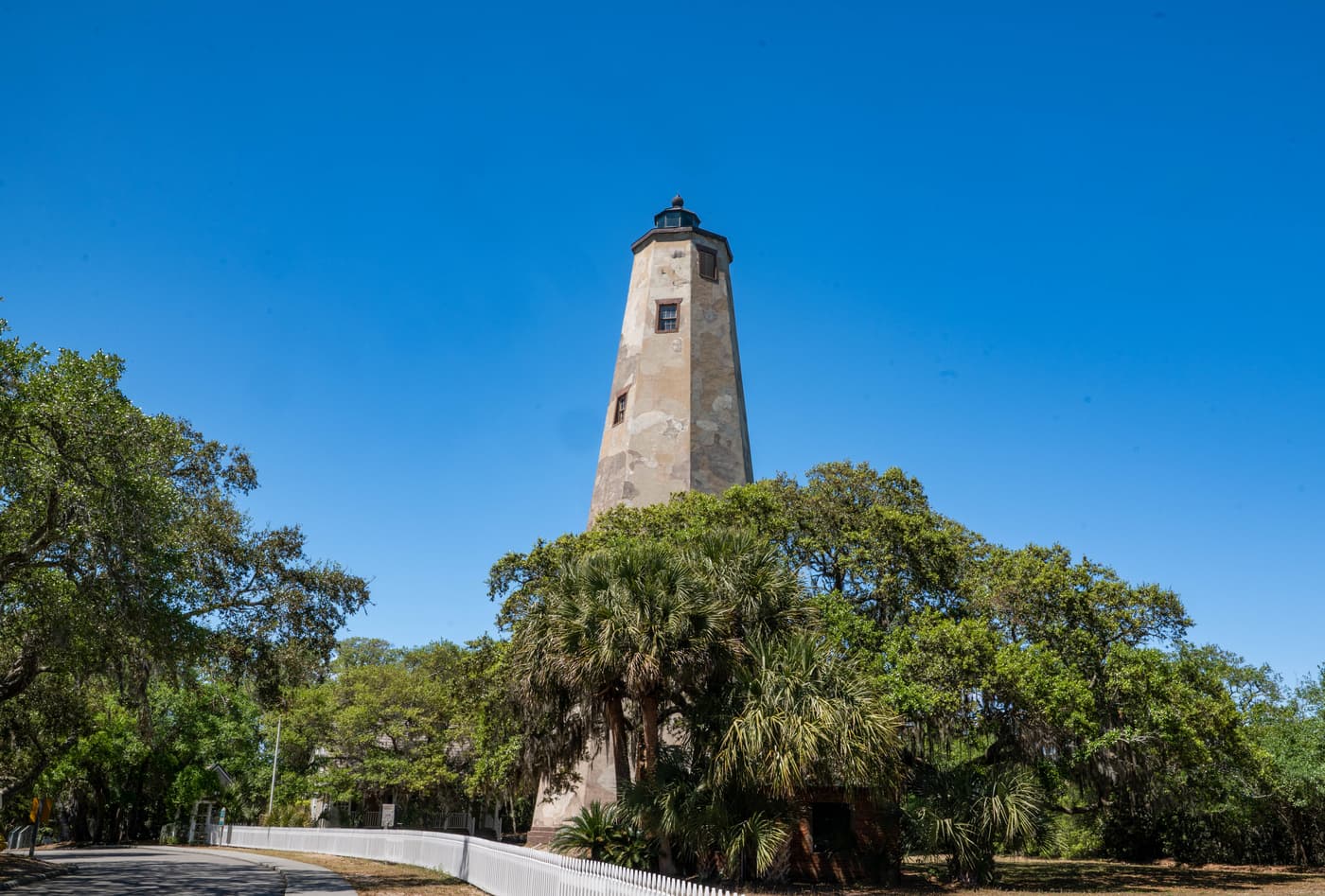
Old Baldy is the oldest standing lighthouse in North Carolina — 110 feet of octagonal brick, finished in 1817, guarding the mouth of the Cape Fear River where it meets the Atlantic. Its name was earned, not given. The original whitewashed plaster has weathered off in mottled patches over two centuries, leaving a streaked, uneven surface that looks more like a piece of pottery than a tower. The Coast Guard could have repainted it any time in the last hundred years; the island chose not to. The patina is the daymark now.
Inside, a wooden staircase climbs through landings of heavy heart pine to a small lantern room at the top. Old Baldy was decommissioned in 1935 — replaced by a more powerful light across the river — and its original lens is long gone. But the tower itself was preserved, restored by the Old Baldy Foundation, and now serves as a small museum to the keepers and pilots who once worked the treacherous Frying Pan Shoals just offshore. The shoals took hundreds of ships before the lights and channel markers caught up.
Bald Head Island is reachable only by passenger ferry from Southport — no cars allowed, only golf carts and bicycles. The lighthouse stands at the edge of the maritime forest, surrounded by live oaks, palmettos, and the slow creak of cicadas. From the lantern room you can see the river meeting the ocean, the long sweep of Cape Fear, and the working light at Oak Island flashing across the water. It is the gentlest lighthouse in the collection — retired, weathered, and still loved by an island that quietly refuses to let it go.


Oak Island Light
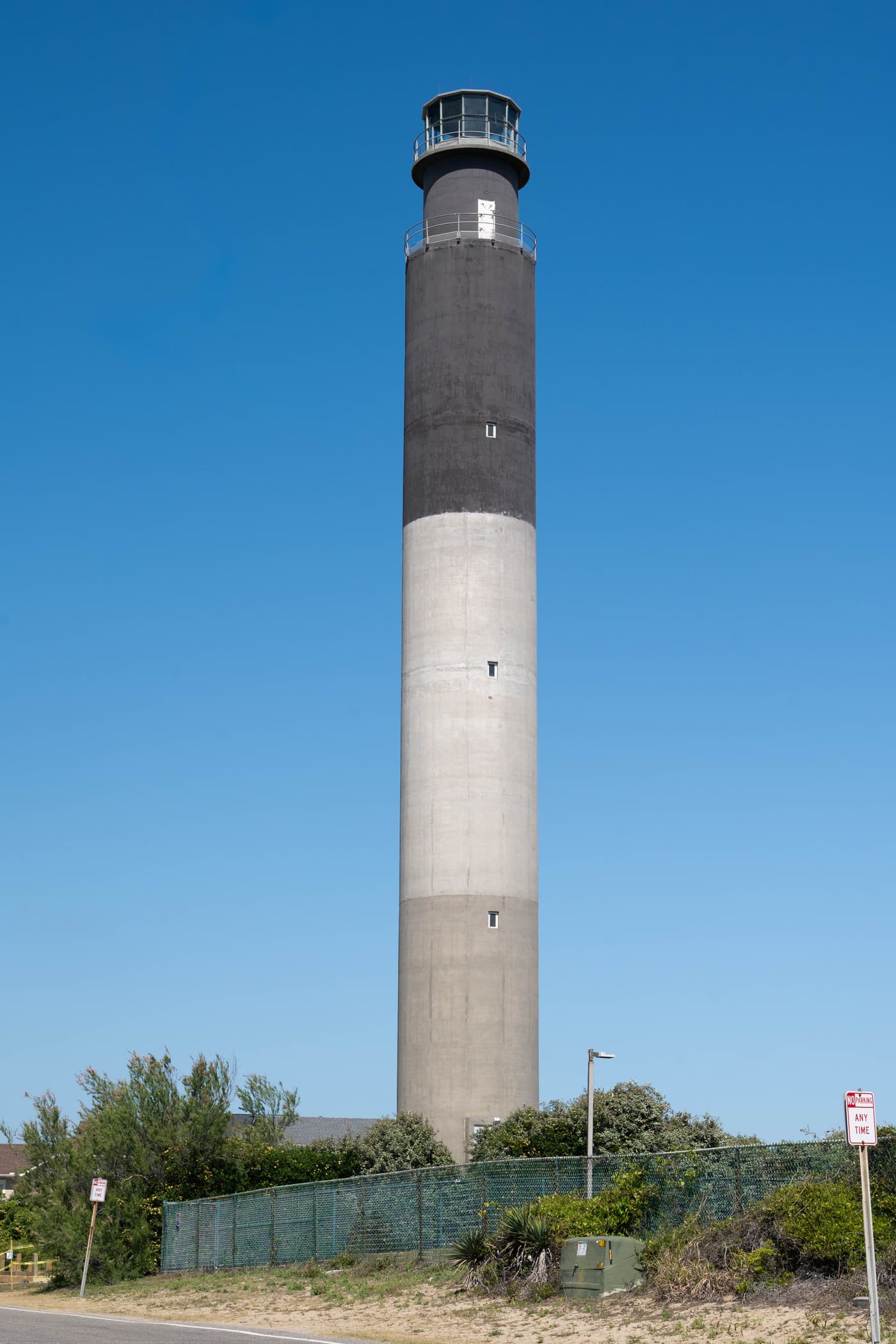
Oak Island Lighthouse is one of the youngest towers in the collection and one of the most powerful lights ever built in the United States. Completed in 1958 — over a century after most of its Atlantic siblings — it rises 169 feet of poured reinforced concrete in three painted bands: a flat gray base, a bright white middle, and a black top. The daymark is unmistakable, a deliberate departure from the brick-and-iron towers of the previous era. Where the older lighthouses look like they grew out of the coast, Oak Island looks like it was set down on it.
Its original beacon produced 14 million candlepower — for a brief period, the brightest lighthouse in the Western Hemisphere — visible 24 nautical miles out to sea. The light still operates today as an active aid to navigation, maintained by the Coast Guard and tended by a small group of trained volunteers from the local community. The interior has no spiral staircase. Climbers ascend a series of ship-style ladders straight up the inside of the cylinder, all 131 rungs, in what may be the most demanding climb of any open lighthouse on the East Coast.
It stands at Caswell Beach on the eastern tip of Oak Island, directly across the river mouth from Old Baldy. At night the two beacons trade glances across the Cape Fear — one steady and retired, one flashing and active — marking opposite shores of the same channel. Oak Island is the lighthouse that proves the form did not end with the nineteenth century. It is taller, brighter, and harder than the towers that came before, but it is doing the same job: telling sailors where the land is. Sometimes the modern answer is the right one.
Sullivan's Island Light
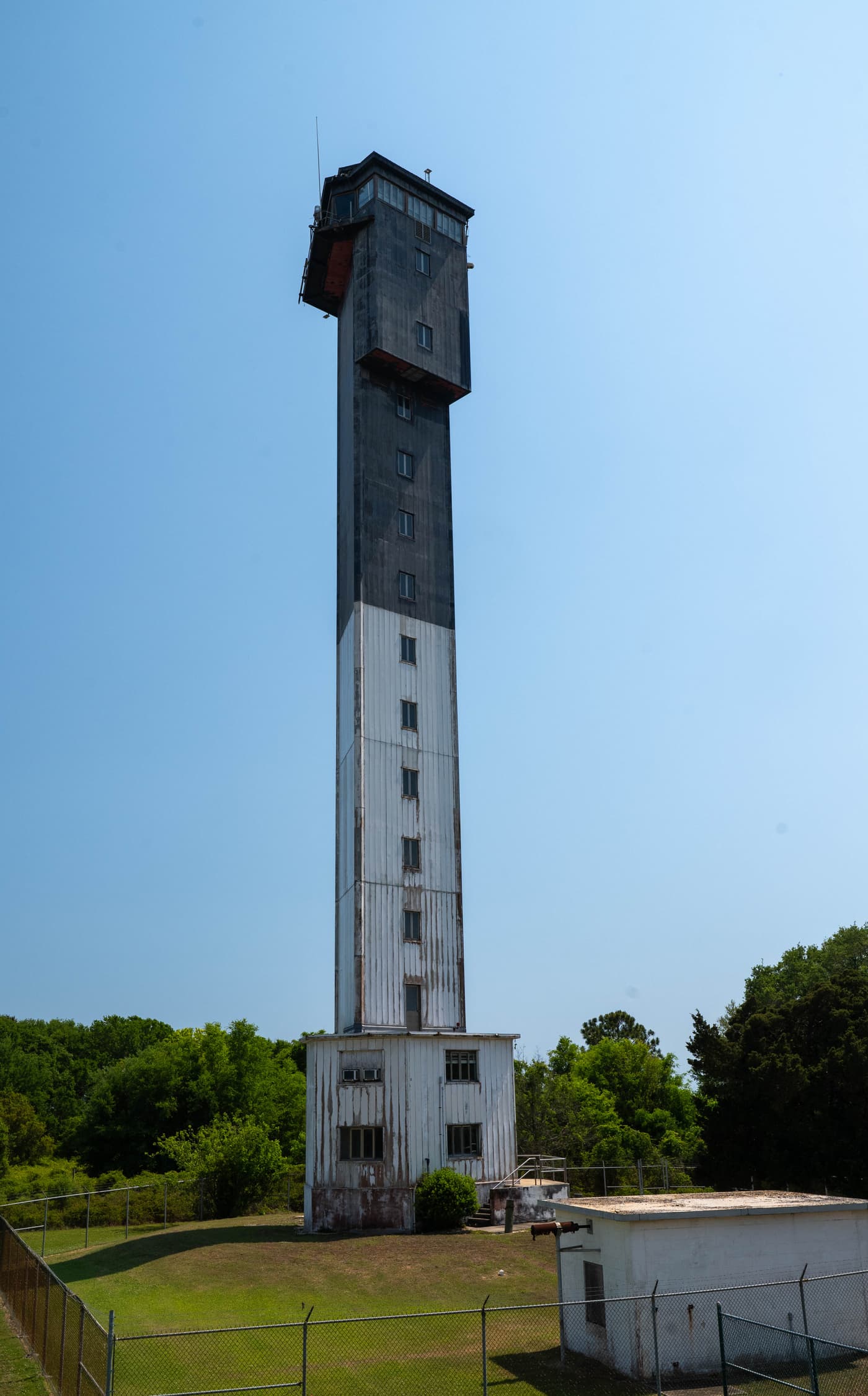
Sullivan's Island Lighthouse is unlike any other tower on the Atlantic coast — a triangular structure of aluminum and reinforced concrete rising 140 feet at the north end of Charleston Harbor, completed in 1962 to replace the abandoned Morris Island Light across the channel. Its three flat sides meet at sharp vertical edges, sheathed in a stark black-and-white daymark that was originally a high-visibility orange. The silhouette is more rocket gantry than lighthouse — a Cold War profile designed in the same decade as the Saturn V, by engineers who treated the tower as an antenna for light. Where every other lighthouse in the collection looks like it grew out of a coastline, Sullivan's looks like it was assembled.
It is the only American lighthouse with an elevator. There is no spiral staircase, no climb of a hundred and something steps to a lantern room — only an enclosed shaft running the height of the structure, designed so that keepers and Coast Guard technicians could ascend in uniform without losing their breath. The original beacon was rated at 28 million candlepower, briefly the second-most powerful lighthouse in the Western Hemisphere, visible 26 nautical miles out to sea. It was so bright that the Coast Guard had to dial it back to keep harbor pilots from being blinded on approach. The interior is closed to the public; the tower remains an active aid to navigation, run by Coast Guard Station Charleston from a base that has guided ships into this harbor for almost three centuries.
It stands at the edge of the maritime forest on the north end of Sullivan's Island, a few hundred yards from Fort Moultrie and within sight of Fort Sumter across the water. From its base the harbor opens — carriers and container ships moving up the channel, the Ravenel Bridge in the haze, salt marshes catching the last light of evening. Charleston spreads behind it, two and a half centuries old. The Morris Island Light — the tower this one replaced — still stands offshore, alone, surrounded by water, its keeper's house and dunes long since taken by the sea. Sullivan's is what came next: faster, harder, lit from within. It is the lighthouse the twentieth century thought a lighthouse should be, and the only one in the collection that does not pretend otherwise.
Morris Island Light
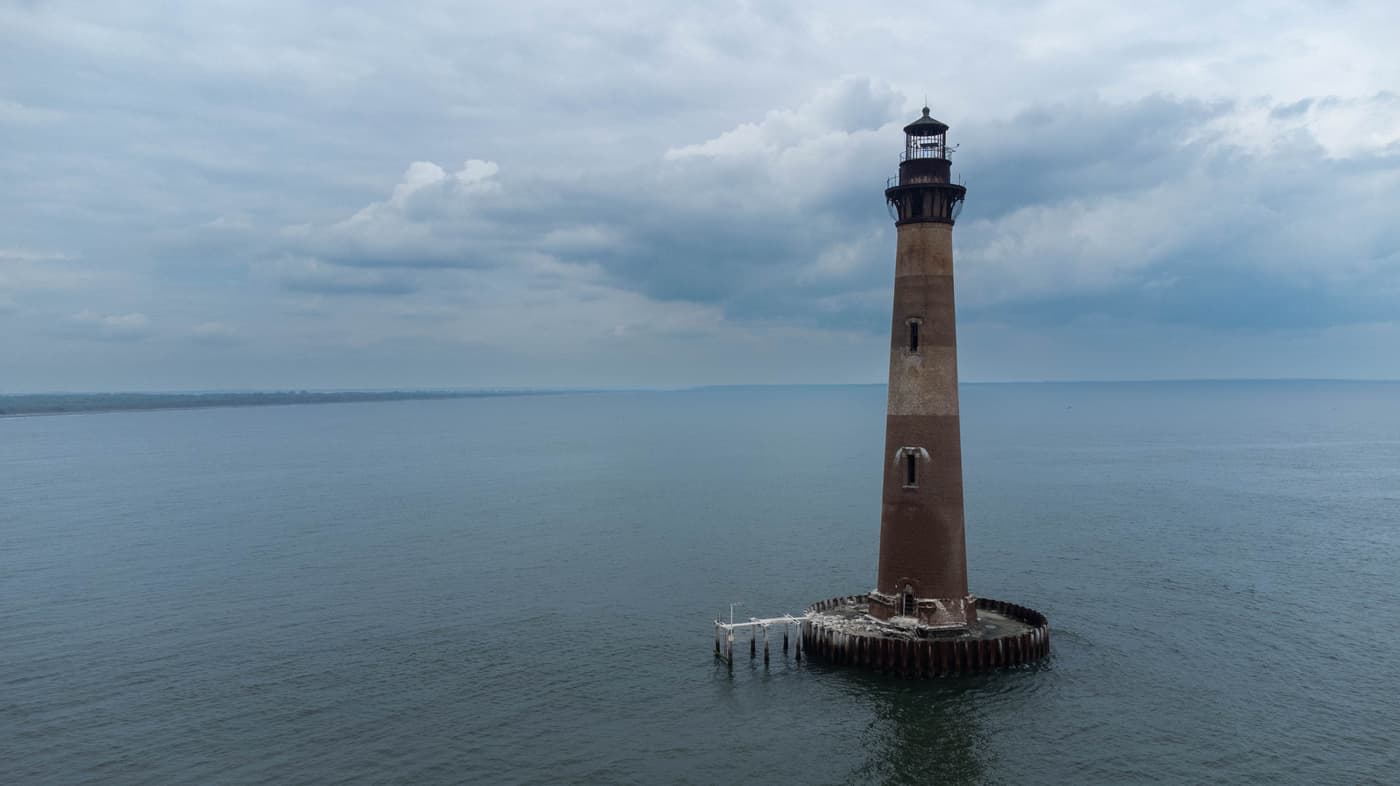
Morris Island Lighthouse stands alone in the Atlantic a mile offshore from Folly Beach, where the channel into Charleston Harbor turns toward the city. The current tower — 161 feet of red brick crowned with a black lantern room — was lit in 1876, the third structure on a barrier island that has since been almost entirely consumed by the sea. The first light here dated to 1767, built by order of King George III to mark the entrance to the colonial port; the Civil War took the second. The third was meant to last forever, and in a sense it has. The island under it has not.
In 1876 the tower stood 1,200 feet inland on a stable barrier island, surrounded by keeper's quarters, cisterns, brick walks, and a working community. By the 1930s, dredging at the harbor mouth and the long Atlantic erosion of the South Carolina coast had brought the surf to its base. The keepers were moved off the island in the 1950s. By 1962 it was decommissioned — replaced by the new Sullivan's Island Light across the channel — and abandoned to the water. The original first-order Fresnel lens was removed. The cottages and the cisterns and the walks were taken by the sea decade by decade. Only the tower remained, surrounded by water on every tide, the original cofferdam-and-piling foundation still holding it upright.
Today the lighthouse stands alone in the open Atlantic — the most photographed abandoned structure on the East Coast and one of the few American lighthouses that can no longer be reached on foot. A nonprofit, Save the Light, raised the money in the early 2000s to stabilize the tower and reinforce its foundation against further erosion. The brick has been re-pointed; the ironwork restored. The lantern room is empty. From the beach at sunrise the tower stands black against the orange sky, half a mile offshore, alone where an island used to be. It is the lighthouse Sullivan's Island replaced — and the lighthouse the Atlantic could not let go of.
Hunting Island Light
Hunting Island Lighthouse is 132 feet of cast iron and brick on a barrier island that has been retreating from the sea for the better part of two centuries. The original 1859 tower was destroyed during the Civil War — Confederate forces removed and disabled the apparatus to deny it to Union ships — and what stands today is the 1875 replacement, built deliberately of bolted iron plates so that it could be disassembled if the coastline ever demanded it. That contingency was not theoretical. By 1889 the Atlantic had eaten so much of the original site that the entire tower was unbolted, transported in sections 1.3 miles inland, and reassembled on the spot it occupies today. Its black-on-white daymark — black above, white below — is the cleanest in the collection. It was designed to move, and it did.
Inside, a cast-iron spiral staircase climbs 167 steps to the lantern room, the metalwork cool to the touch even in Lowcountry heat, the air thick with the smell of old paint and salt. The original second-order Fresnel lens was removed when the light was decommissioned in 1933, but the tower itself was preserved by the State of South Carolina and is now the only publicly accessible lighthouse in the state. Climbers ascend through small landings, each framed by a single porthole window that lets in a slice of pine forest, then sky, then the long flat horizon of the Atlantic. The lantern room sits 132 feet above a forest of loblolly pines and palmettos that did not exist when the light was first lit — the trees, like the lighthouse, are recent arrivals on a coastline that keeps moving.
Hunting Island is a state park now, but it does not feel curated. The road ends in maritime forest — pines, palmettos, live oaks draped in Spanish moss — and the lighthouse rises from the trees with no fanfare, no gift shop crowding its base, no parking lot at its foot. The beach beyond it is a slow disaster of erosion: tall pines toppled into the surf, bleached trunks half-buried in sand, the waterline creeping further inland every year. The Forrest Gump shrimp boat scenes were filmed on this beach. The skeleton trees lining the surf were standing forest a generation ago. The lighthouse stands inland of all of it now, watching its own coastline disappear, holding the ground it was relocated to a hundred and forty years ago and waiting to see whether it will need to move again.
Photos coming soon
Lighthouse pending
Tybee Island Light
Tybee Island Lighthouse is the oldest standing lighthouse in Georgia and one of the most continuously lit beacons on the Atlantic coast — 145 feet of brick and iron at the mouth of the Savannah River. The original tower was commissioned in 1736 by James Oglethorpe, founder of the Georgia colony, only three years after he set foot on these shores. That first structure was a daymark only, but lit towers followed in 1742 and 1773, and the lower 60 feet of what stands today is the 1773 base. The upper 85 feet was rebuilt in 1867 after retreating Confederate troops set the tower on fire in 1862. The seam between centuries is visible if you know where to look. The daymark is unmistakable: a black bottom, a wide white middle band, a black top crowned with a black lantern.
Inside, a cast-iron spiral staircase climbs 178 steps to the lantern room, where the original first-order Fresnel lens still sits in place — one of only a handful in the country still operating from the same tower it was installed in. The lens is nine feet tall, weighs more than a ton, and throws a beam 18 nautical miles out to sea. The Tybee Island Historical Society maintains the entire station today: the lighthouse and five surviving outbuildings — the head keeper's cottage, two assistant keeper cottages, a brick fuel storage, and the original 1812 powder magazine. The complex is one of the most intact eighteenth-century light stations remaining in North America, with original lens, original quarters, and original outbuildings all standing on their original foundations.
Tybee Island sits at the easternmost point of Georgia, a barrier island guarding the mouth of the Savannah River and the long curve of the Lowcountry coast. The lighthouse stands at the north end of the island near the old Fort Screven gun batteries and the strand of dunes where the river meets the ocean. From the lantern room the view runs in every direction — the river running inland toward Savannah, container ships threading the channel, Hilton Head and the South Carolina coast a smudge across the water. The town below is a working beach village, not a resort, with seafood houses and weather-bleached cottages and a pier where the river pilots still board. The light has been throwing its beam from this corner of the coast in some form since the 1730s. There is no lighthouse on the Atlantic that has been doing this longer.
Photos coming soon
Lighthouse pending
Own the collection
Selected lighthouse images are available as fine-art prints — museum-quality, fulfilled by Prodigi, shipped worldwide.
View Prints